Green Martian egg incubator
A Princess of MarsThe Green Martian egg incubator is both a sealed hatching chamber and the pivotal institution in a communal system of reproduction. Its distant placement, five-year cycle, and carefully rationed eggs embody the Green Martians’ attempt to preserve life on a declining planet; its discovery can therefore mean more than the loss of a building, as the destruction of a rival incubator demonstrates.
Structure and First Encounter
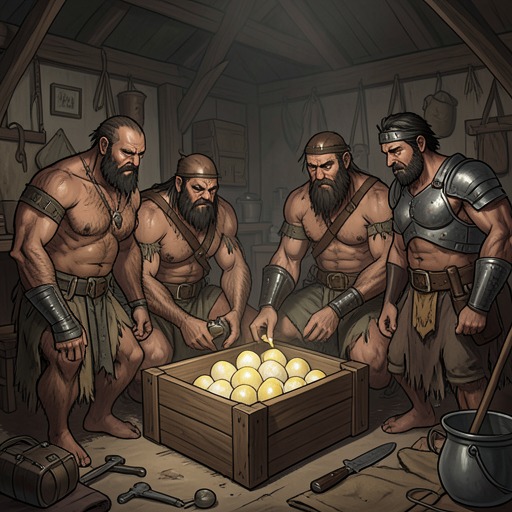
John Carter first sees the incubator while exploring a low structure surrounded by a wall only about four feet high. Its roof is solid glass, four or five inches thick, and below it lie several hundred round, snowy-white eggs, each about two and a half feet in diameter. Five or six have already hatched. Their young, as yet pale yellowish-green and disproportionately large-headed, have long necks and six limbs: two legs, two arms, and a middle pair usable as either. Carter has little time to study them, however; a group of mounted warriors approaches behind him as he watches.
The encounter makes the chamber’s remoteness feel precarious rather than safe. The approaching warriors’ intentions seem sinister, and the rattle of a warrior’s equipment gives Carter the warning that lets him turn toward an enormous spear aimed at his breast. The incubator is thus introduced not as a protected nursery but as an isolated structure exposed to the violence of the world around it.
Selection and the Five-Year Cycle
The incubator forms the last stage of a long system of selection. Each adult female produces about thirteen eggs a year. Eggs that meet size, weight, and specific-gravity tests are hidden in subterranean vaults kept too cold for incubation. A council of twenty chieftains examines them annually, destroying all but about one hundred of the most perfect eggs from each year’s supply. After five years of selection, about five hundred are transferred to an almost airtight incubator, where the sun’s rays hatch them after another five-year period.
The observed hatching is described as typical: all but about one per cent of the eggs hatch within two days. The remaining eggs’ fate is unknown, but they are unwanted because prolonged incubation might be inherited and disrupt a system that lets the adults calculate almost to the hour when they must return to the incubators. The process makes reproduction a matter of communal management and measured timing, rather than a private family event.
The incubators are placed in remote fastnesses to reduce the risk that another tribe will discover them. The reason is explicit: losing an incubator would leave the community without children for another five years. The structures are consequently strategic vulnerabilities as well as reproductive facilities. Their isolation protects a generation in the making, but also leaves that generation dependent on a single site.
Hatching and Communal Upbringing
When Carter later returns with the Thark procession, the incubator is nearly emptied of eggs and crowded with young Martians, three or four feet tall and restlessly seeking food. Lorquas Ptomel and other chiefs approach the enclosure, and Carter is called forward to repeat a leap over the parked chariots. Afterward, the warriors break an opening in the incubator wall large enough for the young to leave.
Women and younger Martians form two lines from the opening, through the chariots, and out onto the plain. The hatchlings race between them, and are caught one by one by women and older children stationed along the route. The young people who catch hatchlings turn them over to women; the women return to their chariots with the children they have taken in. What Carter witnesses is not a family reunion but a public distribution of young among members of the community.
The hatchlings have spent five years inside their eggs and emerge physically developed except for their size. They do not know their mothers, and their mothers could not reliably identify their fathers. The children are treated as belonging to the community, while the females who happen to catch them assume responsibility for their upbringing. That education is narrowly described: the young are taught to speak and to use weapons, with arms supplied from the first year of life.
War, Environmental Pressure, and Significance
The selection system answers the pressure of life on a dying planet, where each additional life places another demand on dwindling resources. The adults choose only the hardiest specimens and regulate births to offset deaths. The incubator therefore concentrates the consequences of that pressure in a visible, countable stock of eggs: a community’s future is selected, stored, and hatched under controlled conditions.
The danger becomes concrete when the Thark party discovers an incubator belonging to the Warhoon. Tars Tarkas finds the cement scarcely dry and concludes that the rival people cannot be more than a day’s march ahead. The warriors tear open the entrance, crawl inside, and smash every egg with their short-swords before rejoining the cavalcade. The episode shows how the same remote placement intended to guard a generation can fail, and how destroying the eggs can deprive a community of children for years.
The incubator’s role reaches beyond reproduction into the novel’s larger conflict over survival and collective life. The young emerge from a sealed chamber into armed custody, while the adults’ careful numerical controls coexist with the possibility of sudden, deliberate annihilation. Its glass roof makes the hatching visible to Carter, but visibility brings no protection: the chamber can shelter a future only while others choose not to break in. The later crisis surrounding the atmosphere plant further situates such reproductive systems within Barsoom’s dependence on fragile, deliberately maintained infrastructure, though the incubator itself is distinct from the machinery that produces the planet’s air.